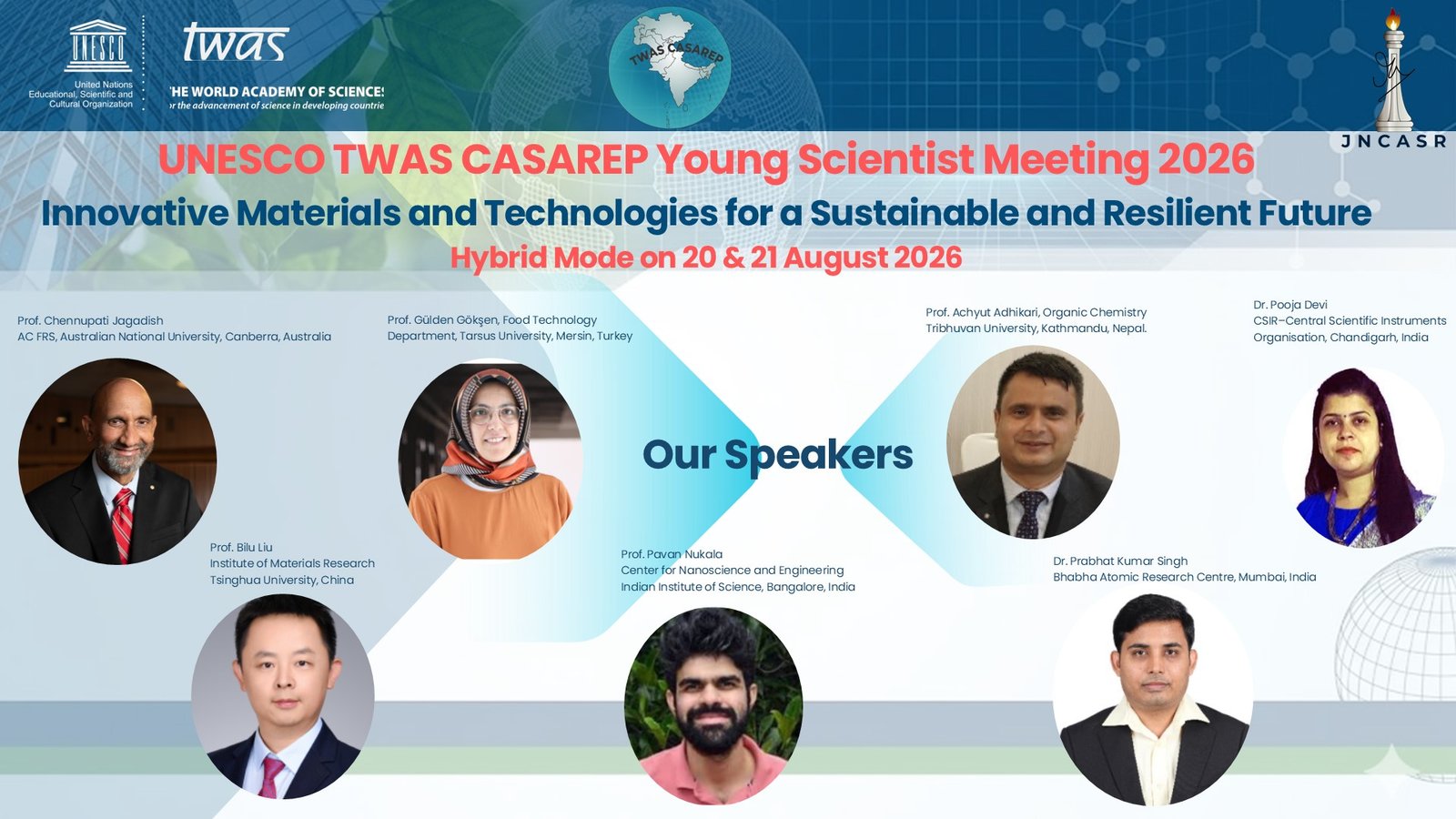
The first day opened with a spirit of intellectual excitement and global scientific exchange. We had three invited lectures, delivered online by distinguished scientists from Australia, China, and Türkiye, covering diverse aspects of advanced materials, clean energy, and sustainable technologies. Taken together, the lectures traced a fascinating arc - from the quantum physics of semiconductor nanostructures and nanowires to the electrochemistry of green hydrogen, and finally to the circular bioeconomy of sustainable food packaging. Although diverse in their approaches and applications, all three lectures highlighted how materials science, when pursued with creativity and purpose, can contribute to a technologically advanced, environmentally sustainable, and resilient future.
The meeting began with an inaugural lecture by Prof. Chennupati Jagadish, Distinguished Professor Emeritus at the Australian National University and recipient of Australia's highest civilian honour, the AC. Prof. Jagadish provided an insightful overview of semiconductor nanostructures, including nanowires, nanomembranes, and microrings, and their applications in electronics, optoelectronics, sensing, and healthcare. His discussion of nanowire and microring lasers, single-photon sources and detectors, and chemical and biosensors coupled with neuro-electrodes demonstrated the remarkable journey from fundamental materials research to applications in communication, computing, healthcare, and the study of brain signalling.
The second lecture was delivered by Prof. Bilu Liu, Tsinghua University, China, who presented his group's work on two-dimensional materials for high-current-density electrolysis and green hydrogen production. A key focus was on homologous metal heteromaterials (HMHs), which combine chemically bonded metallic interfaces with high electrical conductivity and strong interfacial interactions. The lecture provided an excellent example of how fundamental understanding of materials, interfaces, and electrochemistry can contribute to scalable and potentially low-cost technologies for the clean-energy transition.
The final lecture of the day was delivered by Dr. Gülden Gökşen, who presented innovative approaches for converting agricultural, food-processing, and marine by-products into high-value bio-based materials for sustainable food packaging. Her work demonstrated the recovery of cellulose, nanocellulose, proteins, polysaccharides, and bioactive compounds using environmentally friendly approaches, including ultrasound-assisted extraction and natural deep eutectic solvents. These materials can be developed into biodegradable films, edible coatings, and electrospun nanofibrous structures with enhanced barrier, antioxidant, and antimicrobial properties. Her presentation highlighted the potential of integrating green extraction, nanotechnology, and bio-based polymers in developing next-generation active packaging and advancing the circular bioeconomy.
Overall, Day 1 was highly engaging and scientifically diverse, with the lectures successfully connecting fundamental materials research with pressing challenges in energy, healthcare, sustainability, and food security. The participation and interaction of the young researchers made the sessions particularly rewarding.
The meeting began with an inaugural lecture by Prof. Chennupati Jagadish, Distinguished Professor Emeritus at the Australian National University and recipient of Australia's highest civilian honour, the AC. Prof. Jagadish provided an insightful overview of semiconductor nanostructures, including nanowires, nanomembranes, and microrings, and their applications in electronics, optoelectronics, sensing, and healthcare. His discussion of nanowire and microring lasers, single-photon sources and detectors, and chemical and biosensors coupled with neuro-electrodes demonstrated the remarkable journey from fundamental materials research to applications in communication, computing, healthcare, and the study of brain signalling.
The second lecture was delivered by Prof. Bilu Liu, Tsinghua University, China, who presented his group's work on two-dimensional materials for high-current-density electrolysis and green hydrogen production. A key focus was on homologous metal heteromaterials (HMHs), which combine chemically bonded metallic interfaces with high electrical conductivity and strong interfacial interactions. The lecture provided an excellent example of how fundamental understanding of materials, interfaces, and electrochemistry can contribute to scalable and potentially low-cost technologies for the clean-energy transition.
The final lecture of the day was delivered by Dr. Gülden Gökşen, who presented innovative approaches for converting agricultural, food-processing, and marine by-products into high-value bio-based materials for sustainable food packaging. Her work demonstrated the recovery of cellulose, nanocellulose, proteins, polysaccharides, and bioactive compounds using environmentally friendly approaches, including ultrasound-assisted extraction and natural deep eutectic solvents. These materials can be developed into biodegradable films, edible coatings, and electrospun nanofibrous structures with enhanced barrier, antioxidant, and antimicrobial properties. Her presentation highlighted the potential of integrating green extraction, nanotechnology, and bio-based polymers in developing next-generation active packaging and advancing the circular bioeconomy.
Overall, Day 1 was highly engaging and scientifically diverse, with the lectures successfully connecting fundamental materials research with pressing challenges in energy, healthcare, sustainability, and food security. The participation and interaction of the young researchers made the sessions particularly rewarding.